-

An Incomplete* Listing of Los Angeles Libraries, Reading Rooms, and Archives
22.5 × 34 inches, unfolded
Offset printed on newsprint
Design by IN-FO.CONow Shipping the 2nd edition!
Each poster purchase supports the free distribution of 2 copies of the map within LA County. Thank you for your support in raising awareness of LA County Libraries, Archives and Reading Rooms!
This is the second edition of An Incomplete* Listing of Los Angeles Libraries, Reading Rooms, and Archives, a growing directory of freely accessible reading spaces in LA County. Beyond the collections and knowledge they house, these spaces provide essential services to LA County’s 10+ million residents.
The Institute of Museum and Library Services (IMLS) — the primary federal agency supporting libraries and museums across the country — is under active threat of elimination. This map is offered as a tool to stay engaged and continue advocating for libraries as one of the last truly accessible public spaces, and a vital part of our shared civic life.
Published by Inventory Press in collaboration with the Vera List Center for Art and Politics, this is the second map in a series initiated and conceptualized by the VLC, beginning with An Incomplete* Listing of NYC Libraries, Reading Rooms, and Archives.
*This by-no-means comprehensive listing of Los Angeles County spaces is unfinished and awaits updates, additions, and corrections. -

the eight directions of the wind
7.5 × 10.75 inches, 104 pages, softcover
ISBN 978-1-941753-97-2
Published by Inventory Press & The Huntington
Design by IN-FO.CO
British artist and writer Edmund de Waal (b. 1964) is known for the his installations of exquisite porcelain vessels in historic spaces and his engagement with the potential of ceramics. At The Huntington, de Waal’s interventions and artworks explore the movement of ideas, people, and objects—what Chinese poet Bei Dao calls the “eight directions of the wind.” Three interactive and contemplative spaces in the Chinese and Japanese Gardens—on porcelain and on shadow—and the Art Gallery—on sanctuary—encourage visitors to consider the implications of migration and exile, the material history of porcelain, and the power of sanctuary, resulting in fresh perspectives and new experiences of The Huntington’s collections.
Fully illustrated, the catalogue also includes an in-depth conversation between de Waal and cultural historian Josh Kun about the project’s connection to Los Angeles’s mix of cultures and the transmission of ideas. A selection of poems on exile that speaks to global histories of migration completes this thought-provoking tour through The Huntington’s iconic spaces. -

Songlines
8.5 × 10 inches, 144 pages, hardcover
ISBN 978-1-970449-06-8
Published by Inventory Press & Minneapolis Institute of Art & San José Museum of Art
Design by IN-FO.CO
María Berrío: Songlines traces the arc of the last ten years of the artist's practice with attention to her work’s material structure and conceptual underpinnings. Working at a large scale, in a process she describes as “painting with paper,” Berrío builds scenes out of cut and torn papers that blend myth and folklore with the contemporary world. Berrío embraces multiple storylines, inspired by personal and shared mythologies drawn from across time and geography, ranging from the Colombian countryside of the artist’s birth, to ancient Greek mythology, from contemporary migration crises, to a changing climate. These many references coalesce into vibrant compositions opening onto new worlds.
Published on the occasion of a nationally touring exhibition, Songlines includes texts by Berrío, Katherine Brodbeck, co-curators Lauren Schell Dickens and Leslie Ureña, and an interview with the artist by Valéria Piccoli, alongside copious illustrations and details of Berrio's spellbinding work. -

Coyote Time | Counterpublic 2026
8.25 × 11.75 inches, 304 pages, hardcover
ISBN 978-1-970449-04-4
Design by OmnivoreCounterpublic’s third triennial edition, Coyote Time, presents 50 artist commissions and historical reinterpretations in sites throughout St. Louis. Envisioning a shared near future with boldness and hope at a time of global upheaval, the publication includes commissioned essays, poetry, and visual responses as well as a climate action framework for bi- and triennials. The exhibition is curated by Jordan Carter, Raphael Fonseca, Stefanie Hessler, Nora N. Khan, and Wanda Nanibush with Artistic and Executive Director, James McAnally. Contributors include curatorial texts and works by Raven Chacon, Jacqui Germain, Alexis Pauline Gumbs, N. Katherine Hayles, Josué Mejía, Shahyar Nashat, Suzanne Treister, Kathryn Yusoff, and more. Coyote Time will be the primary document for thought leadership and exhibition interpretation. It will serve as an archive and manual of the Triennials' curatorial ideas, artworks, processes and scholarly contributions including commissioned essays, poetry, and visual responses as well as a climate action framework for bi- and triennials.
-

The Endless Line | Gesture, Painting, Technics
5.5 × 7.75 inches, 320 pages, softcover
ISBN 978-1-941753-87-3
Design by Scott Vander Zee
Available for Pre-order
Shipping November 2026
"Jan Tumlir’s The Endless Line uncovers the concept, language, and theory of gesture in painting as it transitions through time—within and beyond the medium—evolving from the very site where such ruminations and pictorial experimentations begin: the classroom. I found this book to be an excellent resource and recommend it to painters at every stage of their development, from those just beginning to those with long-established practices."
—Laura Owens
"This is an extraordinarily rich and ambitious book, wide-ranging yet thoughtfully constructed and in control of its arguments. Tumlir is a lucid and engaging writer and the text, while admirably erudite, is never stodgy or drily academic. The result is a major contribution to the philosophy and theory of art, art criticism, and the historiography of art—to say nothing of its implications for media studies, film studies, and a broad array of further disciplines."
—Molly Warnock
Jan Tumlir’s The Endless Line supplies us with a general theory of gesture alongside a complementary theory of aesthetics, which together look to history and the future, reconciling the thoughts of such figures as Immanuel Kant and Clement Greenberg, on one end, with those of André Leroi-Gourhan and Gilbert Simondon, on the other. Along the way, philosophical musings on the nature and purpose of art are correlated with the realities of our contemporary technocratic condition. A crucial insight of this book is that gestures bridge the gap between the human and nonhuman spheres.
The conventional progression of figuration is here insistently problematized. Tumlir demonstrates that gestures do not have clean edges and cannot be reduced to purely subjective constructs. Rather, they are forms of expression that emerge from individual interiors only to receive the imprint of their worldly surroundings. From this perspective, the gestures that take shape within painting, a central concern of this work, cannot be confined to the medium; they travel between a wide range of media. The author argues this point by mapping aesthetic philosophy onto the social sciences, covering linguistics, information theory, media studies, and cybernetics. Tumlir’s ambitious book tracks forward and backward through time, consistently alighting on the most emblematic gesture of all: that of searching. -
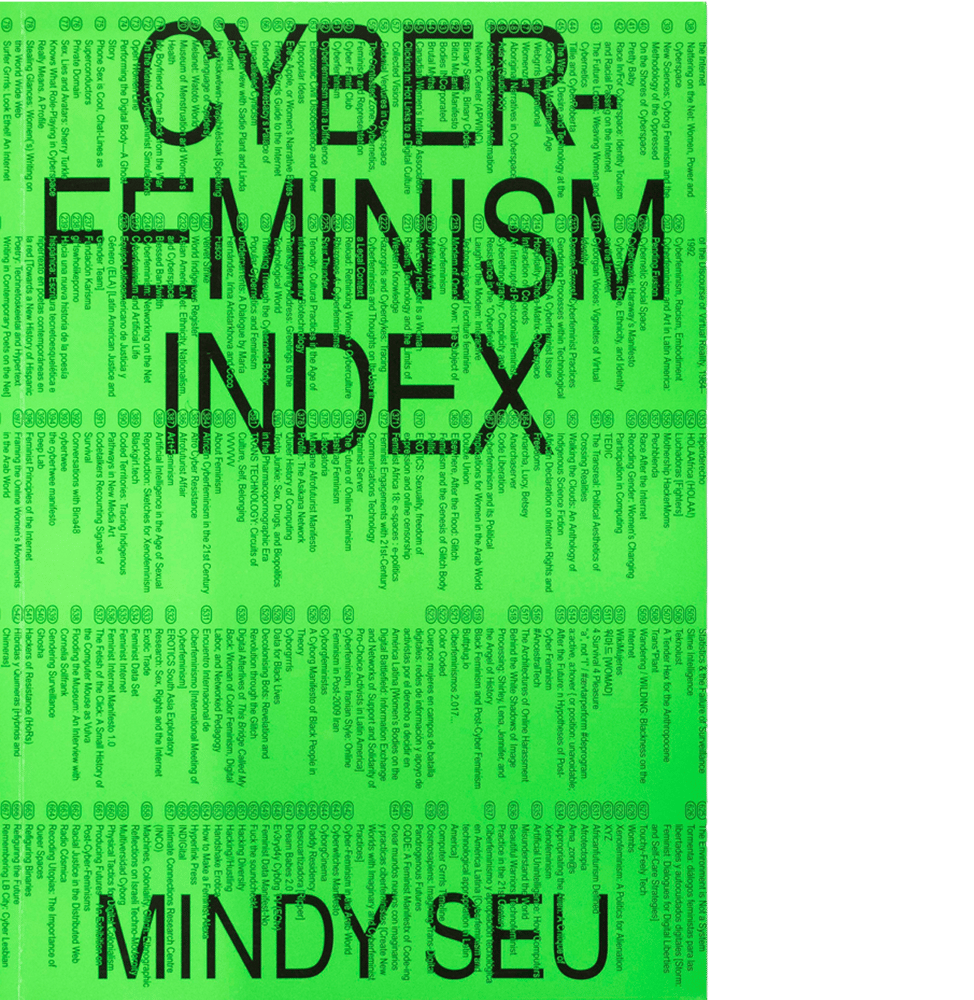
Cyberfeminism Index
6.75 × 9.5 inches, 608 pages
ISBN 978-1-941753-51-4
Design by Laura Coombs
Now Shipping!
“This invaluable research tool will hugely expand, update, and perhaps even revolutionize the feminist discourse. It might even be considered a work of conceptual art in itself."
—Lucy R. Lippard, author of Six Years: The Dematerialization of the Art Object from 1966 to 1972
“This book served as my doorway to cyberfeminism and I now see what an energetic continent awaits me. Anywhere I stepped it burned my hair off, it’s that brilliantly intense."
—Kevin Kelly, founding editor Wired magazine
In Cyberfeminism Index, hackers, scholars, artists, and activists of all regions, races and sexual orientations consider how humans might reconstruct themselves by way of technology. When learning about internet history, we are taught to focus on engineering, the military-industrial complex, and the grandfathers who created the architecture and protocol, but the internet is not only a network of cables, servers, and computers. It is an environment that shapes and is shaped by its inhabitants and their use.
The creation and use of the Cyberfeminism Index is a social and political act. It takes the name cyberfeminism as an umbrella, complicates it, and pushes it into plain sight. Edited by designer, professor, and researcher Mindy Seu, it includes more than 700 short entries of radical techno-critical activism in a variety of media, including excerpts from academic articles and scholarly texts; descriptions of hackerspaces, digital rights activist groups, and bio-hacktivism; and depictions of feminist net art and new media art.
Both a vital introduction for laypeople and a robust resource guide for educators, Cyberfeminism Index—an anti-canon, of sorts—celebrates the multiplicity of practices that fall under this imperfect categorization and makes visible cyberfeminism’s long-ignored origins and its expansive legacy.
“You can use it as a reference, follow a thread, or just access it at random and it delivers wit and wisdom from over three decades of one of the most politically and intellectually challenging movements of our era. What happens between sexed flesh and gendered tech? More than ever we all need to know."
—McKenzie Wark, author of A Hacker Manifesto
“This is an archive perfectly suited to its material: at ease with impermanence, richly appreciative of contradiction, and expansive in scope. Mindy Seu and her cohort of collaborators celebrate the polyrhythmic chorus of voices that have made cyberfeminist thought so delightfully difficult to define—and invite new, kaleidoscopic reinterpretations of our last three decades of life online."
—Claire L. Evans, author of Broad Band: The Untold Story of the Women Who Made the Internet
“The Cyberfeminism Index celebrates, troubles, and critiques the histories and futures of struggle against networked patriarchy—from its first libidinous eruptions to tenacious tactical disruptions and mutations. For theorists and hegemony hackers alike the Index offers an inspirational and educational resource for the urgent work of glitching and decolonizing intersectional internets now."
—Ruth Catlow, founder of Furtherfield